Checkbox is used by many legal and business teams for its no-code workflow automation. The platform allows users to build forms, decision trees, and document flows without needing developers. Several users praise it for the ease of setup and speed it offers.
However, as legal operations in sectors such as BFSI and telecom mature, many teams start to feel that Checkbox is holding them back.
For instance, several users have noted that Checkbox struggles with very complex workflows or unique use cases. As a workflow grows in Checkbox’s visual editor, it can become messy and confusing to navigate, making large-scale or branched processes harder to manage. Some users also found that the platform becomes sluggish when handling large or complex app structures. Another common complaint is the lack of flexibility in Checkbox’s front-end design, making it less customizable than many other platforms on the market.
For these and other reasons, organizations are turning to next-gen alternatives that could better unify automation, analytics, and compliance within one governed environment. Users growing out of Checkbox look for contract intelligence infrastructure that connects drafting, approval, and data insights across departments.
In this article, we’ll explore the top Checkbox alternatives for 2025, highlighting their strengths, drawbacks, and pricing to help legal and operations leaders choose the right fit for their teams.
Top Checkbox Alternatives for Legal Teams in 2025
Legal teams looking beyond Checkbox have a long list of contract lifecycle management (CLM) and automation platforms to choose from. We've compiled for you a list of the best options for 2025 and beyond, with comprehensive overviews of each provider’s strengths, use cases, and pricing plans.
But before getting into the details, see how they compare at a glance. The summary below shows where each platform stands on capabilities that are most relevant to legal professionals.
Feature Overview Table
Feature
Avokaado
Ironclad
Juro
Contractbook
SpotDraft
DocuSign CLM
ContractWorks
Icertis
AI-assisted drafting
Yes
Yes
Yes
Yes
Yes
Yes (via plugin)
Partial (premium plan only)
Yes
Structured data output
Yes
Yes
Yes
Yes
Yes
Yes
Yes
Yes
Clause-level templates
Yes
Yes
Partial (templates only, no separate clause library)
Yes
Yes
Yes
Yes
Yes
End-to-end CLM coverage
Yes
Yes
Yes
Yes
Yes
Yes
Yes
Yes
E-signature integration
Yes
Yes
Yes
Yes
Yes
Yes
Yes
Yes
Native analytics/dashboard
Yes
Yes
Yes
Yes
Yes
Yes
Yes
Yes
Pre-approved template control
Yes
Yes
Yes
Yes
Yes
Yes
Partial (limited advanced clause governance)
Yes
Multi-department collaboration
Yes
Yes
Yes
Yes
Yes
Yes
Yes
Yes
Custom workflows
Yes
Yes
Yes
Yes
Yes
Yes
Yes
Yes
Integration with Salesforce
Yes
Yes
Yes
Yes
Yes
Yes
Yes
Yes
GDPR compliance
Yes (EU-based platform, GDPR and eIDAS compliant)
Yes
Yes (UK/EU-based platform)
Yes (SOC 2 and GDPR compliant)
Yes
Yes (EU data options available)
Yes (DPA available via Onit)
Yes
Governance and audit controls
Yes
Yes
Yes
Yes
Yes
Yes
Yes
Yes
Usage-based pricing model
Yes (modular)
No (mixed)
Yes
No (mixed)
Yes
No
Yes
No (enterprise licensing)
Free trial or self-serve access
No (demo only, no free trial)
No (demo only, no free trial)
No (demo only, no free trial)
Yes (14-day free trial)
No (demo only, no free trial)
No (demo only, no free trial)
Yes (14-day free trial)
No (demo only, no free trial)
Quick deployment
Yes (guided onboarding)
No (complex implementation)
Partial (user-friendly but some setup needed)
Yes (but can take months for complex scopes)
Yes (fast setup)
No (lengthy rollout)
Partial (quick to start, full setup takes time)
No (long enterprise onboarding)
1. Avokaado: Best for AI-Native Contract Intelligence and Governed Automation
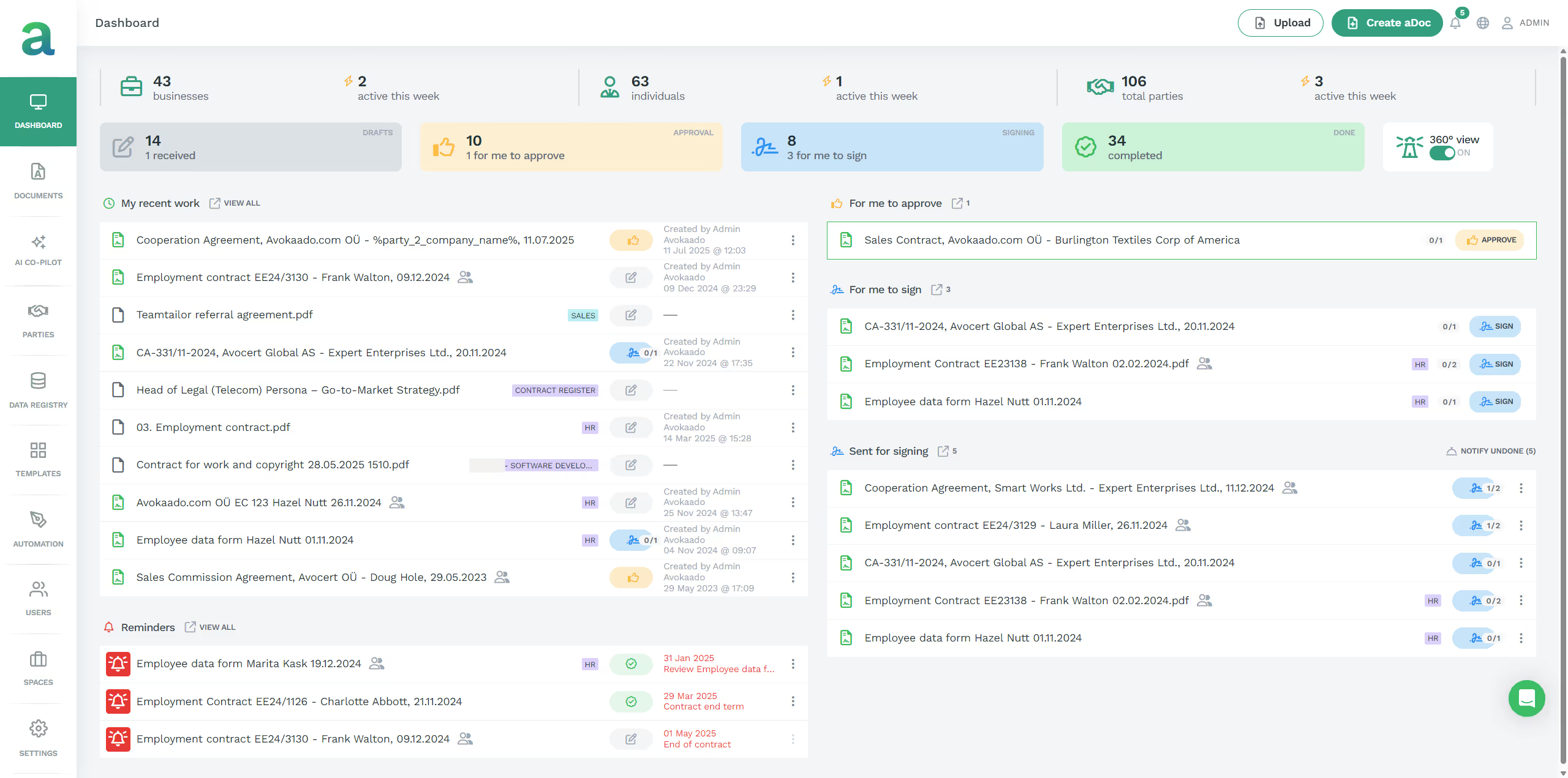
Avokaado is a contract intelligence platform that aims to replace fragmented tools with a single, governed system for drafting, negotiation, signing, and post‑signature management. Avokaado’s platform is built around structured data, compliance, and automation. It is designed for company‑wide use (including Legal, Sales, HR, and Procurement departments) with legal guardrails, turning contracts into structured data right off the bat so teams can gain visibility, compliance, and faster cycle times.
Avokaado’s Key Features
aDoc smart document format: Clause‑based, logic‑driven templates that link content, variables, workflows, and data to keep every version consistent and traceable
Compliance, governance, and security: GDPR‑compliant storage, audit logs, approval flows, template permissions, and branded secure workspaces, with appropriate data encryption protocols in place
Data and parties registries: Treats contracts as data, enabling search, reporting, renewal tracking, and obligation visibility across counterparties
Integrated e-signature and workspace: Draft, collaborate, sign, and archive in one place; reduce too-hopping and version sprawl
Integrations: Connects with major platforms like Salesforce, Workday, BambooHR, Teamtailor, and more to auto‑populate fields and sync status
Expert-led onboarding and fast time-to-value: Customers can launch quickly (often under a week), with a 24‑hour pilot path available for initial validation
AI-native automation (Avo Agents): Avokaado’s Avo, an AI-native infrastructure, converts your playbooks, rules and business context into AI agents. Avo Agents cover the entire contract lifecycle from drafting and review to renewal and destruction with built-in verification, transparency, and auditability.
Pros and Cons of Avokaado
Pros
Cons
Single source of truth across departments; legal maintains guardrails while business users self-serve
Short orientation needed to adopt aDoc logic and structured workflows
EU-built with GDPR alignment and enterprise-grade access controls
Advanced analytics and some controls are available in higher tiers
Usage-based pricing aligns cost to modules and activities, not seats, supporting broad adoption
Playbook setup requires initial input from Legal to capture must/fallback/escalate rules
Demonstrated results in regulated industries (e.g., Tele2 NDA processing reduced from 50 hours to 50 minutes)
Governed AI capabilities like Verifier and Scorecard will be part of Avokaado’s upcoming Avo upgrade; these aim to improve automation, trust, audit readiness, and consistency
Avokaado Pricing
Avokaado offers fully custom pricing built around your exact workflows. Instead of inflexible, pre-defined packages, each plan is tailored to your use cases. It combines only the modules and tools you ask for, from automation and AI to governance and integrations. You pay for exactly what you use, no extra fees and no surprise charges. This pricing model is transparent and offers maximum value and scalability to every customer.
Where Avokaado Wins Over Checkbox
Data, not documents: Contracts are converted into structured data for search, reporting, obligations, and renewals, reducing risk and manual effort.
Company‑wide adoption with oversight: Avokaado empowers Sales, HR, and Operations to self‑serve while preserving legal control and compliance.
Proven in regulated sectors: The platform is built on a GDPR‑aligned foundation in the EU and has demonstrated real impact in BFSI, telecom, and other sectors.
From forms to intelligence: While Avokaado already structures contracts as data, it’s also preparing to launch AI‑native governed agents that will elevate contract workflows even further.
2. Ironclad: Best for Enterprise Workflow Customization
One of the most established players in the CLM market, Ironclad is well‑known for its extensive workflow configurability and enterprise‑grade integrations. Its primary focus is enabling large organizations to standardize approvals and contract creation at scale. Ironclad’s users have lauded its powerful workflow builder and detailed audit capabilities as key strengths. Some, though, have noted that initial setup and configuration can be complex for new teams.
Flexible, highly configurable workflows suited to enterprise environments
Implementation and onboarding can be lengthy due to system complexity
Mature integration ecosystem with leading business tools like Salesforce and Slack
Pricing is higher than average, limiting accessibility for mid-market companies
Reliable audit trail and compliance-oriented reporting
Some reviewers have reported the Salesforce connector is clunky or requires too many clicks
Advanced features, like redlining automation and contract analytics, well-rated by enterprise users
Ironclad Pricing
Ironclad follows a custom enterprise pricing model, typically based on contract volume and user scope. No public pricing is available, but users on multiple legit review platforms have described it as positioned at the upper end of the CLM market.
Where Ironclad Wins Over Checkbox
While Checkbox focuses on form‑based automation, Ironclad offers end‑to‑end contract lifecycle control, and thus, greater enterprise depth
Tight alignment with Salesforce, Slack, and DocuSign, which creates an interconnected workflow that Checkbox cannot replicate
Built for global organizations managing thousands of contracts with multi‑level approval flows and audit needs
3. Juro: Best for Collaborative Contract Creation
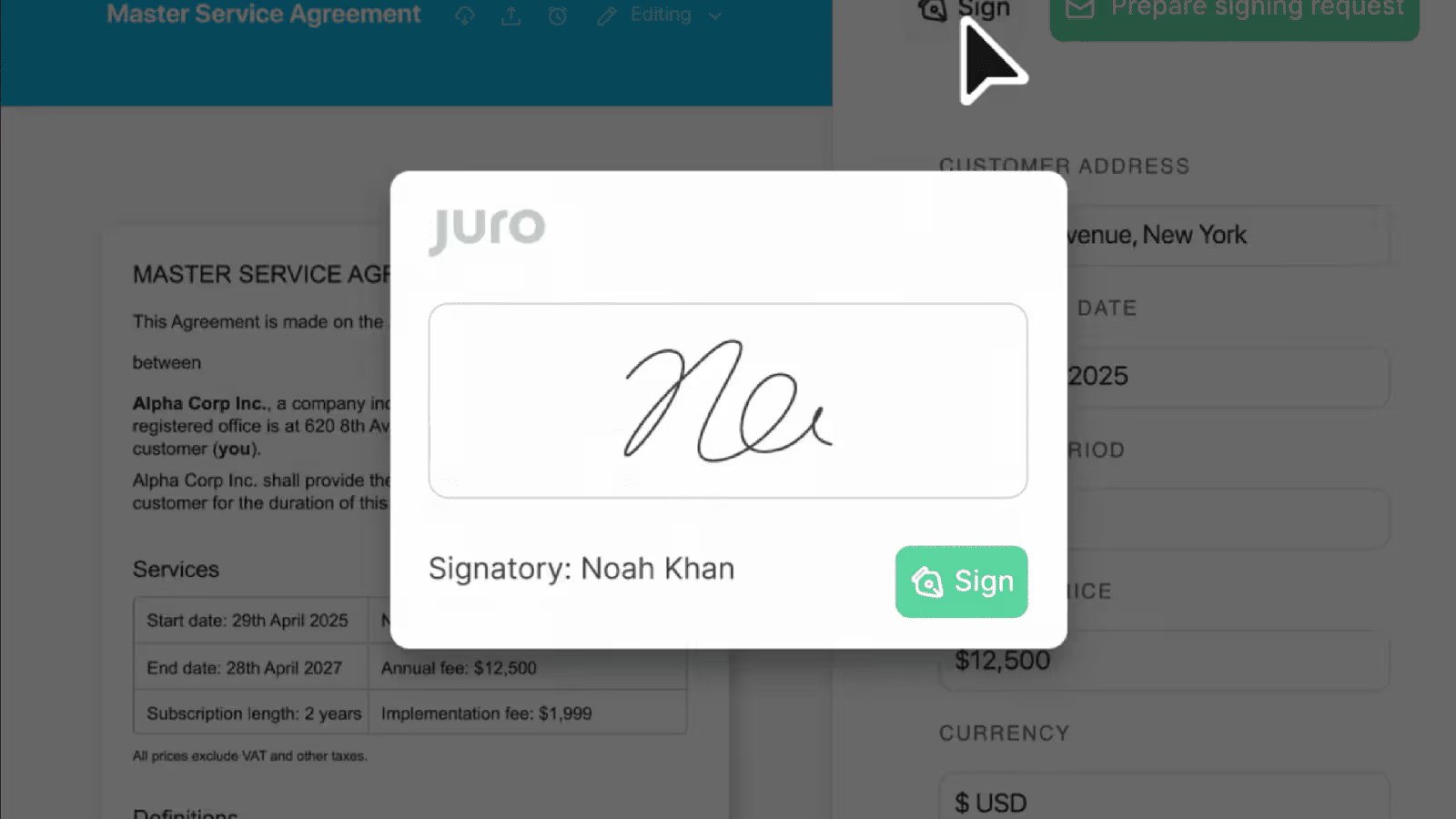
Juro is a browser-based contract collaboration platform that streamlines the entire contract lifecycle inside a unified interface. Built primarily for fast-growing legal and commercial teams, Juro focuses on simplicity, usability, and real-time collaboration. While Juro has become well-known for its intuitive interface and rapid implementation, some users note that its advanced analytics and AI capabilities still need some work.
Juro’s Key Features
All-in-one editor
E-signature and contract tracking
Pre-approved templates for brand and legal consistency across teams
Integrations with third parties
Dashboards to provide contract status visibility and renewal reminders
Pros and Cons of Juro
Pros
Cons
Exceptionally easy to learn and deploy for small to mid-sized teams
Limited automation and AI-driven insights compared to enterprise CLMs
Integrated negotiation and e-signing eliminate tool-switching
Reporting functions are basic and may not be ideal for high-volume contract analytics
Highly rated customer support and onboarding experience
Juro Pricing
The actual costs of using Juro can vary based on factors such as your usage level, the types of integrations you want, and the level of AI automation you would like to achieve. Quotes are provided after you book a personalized demo.
Where Juro Wins Over Checkbox
Offers true collaborative editing and negotiation instead of form-based submission workflows
Easier setup and faster adoption for lean legal teams
Built specifically for collaboration-first contracting
4. Contractbook: Best for Data-Driven SMBs
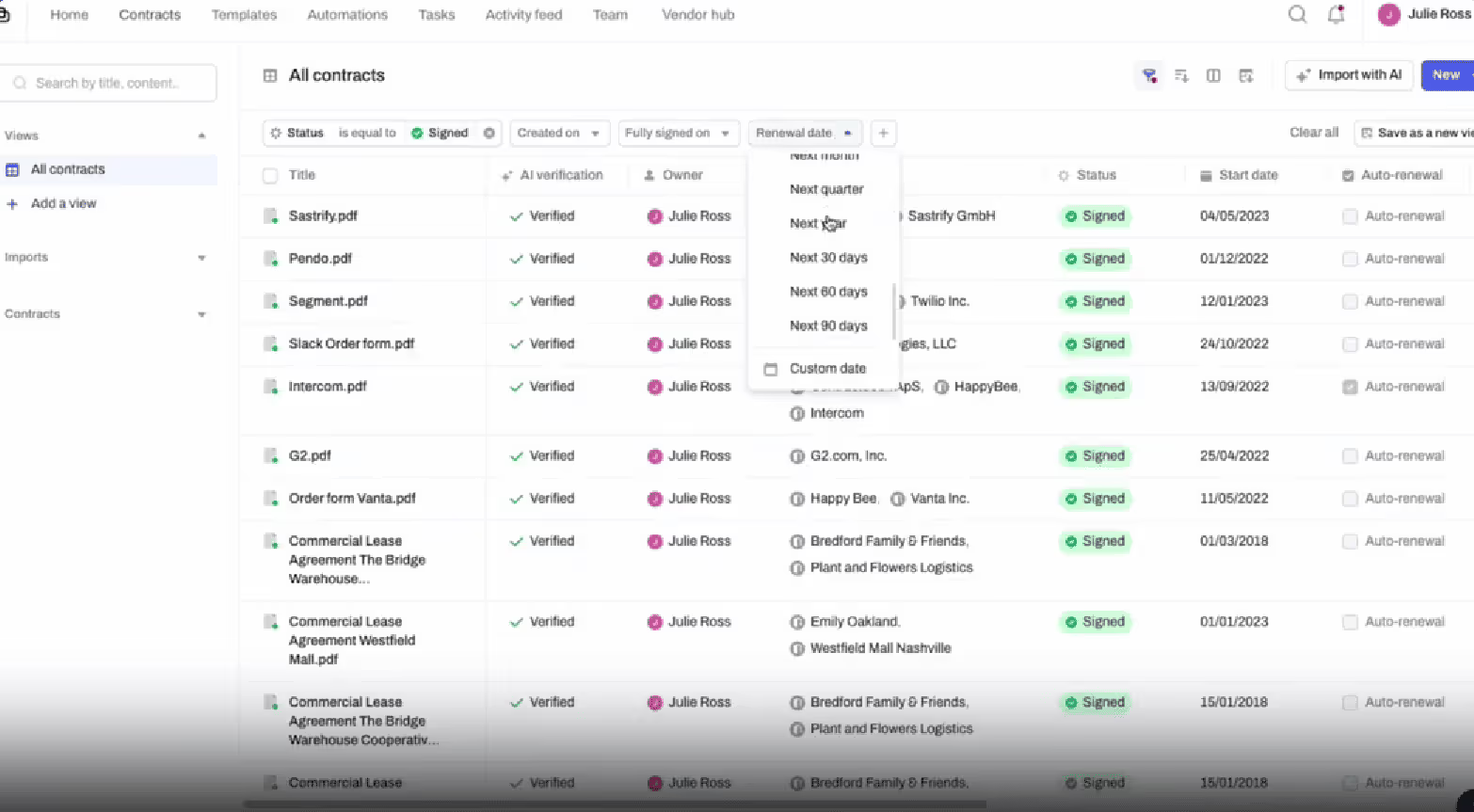
Contractbook focuses on structured data and integrations, enabling organizations to use contract data as a source of truth. It targets small and mid-sized businesses looking to digitize and connect their contract workflows with other business apps. Some Contractbook reviews have praised its intuitive template builder and hassle-free automation capabilities, while others have expressed concerns about limited customization, especially for complex enterprise use cases.
Contractbook’s Key Features
Template and automation engine
Data-first structure
Easy integration for connecting to HubSpot, Pipedrive, and Zapier
Collaboration and notifications
Pros and Cons of Contractbook
Pros
Cons
Affordable and accessible for smaller businesses
Doesn’t offer the kind of complex approval hierarchies or clause-level controls that an enterprise CLM might
Excellent integration ecosystem for CRM and operations tools
Some users claim limited workflow customization
Clean, modern UI suitable for non-technical users
Contractbook Pricing
Contractbook lists four packages on its pricing page: Essential, Centralize, Accelerate, and Custom (quote‑based). You can choose one based on your expected usage and other feature requirements. It also offers a free 14-day trial.
Where Contractbook Wins Over Checkbox
Converts static documents into structured, searchable data for greater visibility
Simplifies automation for SMBs without heavy IT dependence
Delivers better CRM and marketing workflow integrations than Checkbox
Stronger data connectivity and workflow automation across business systems
5. SpotDraft: Best for Legal Ops Teams Scaling Automation
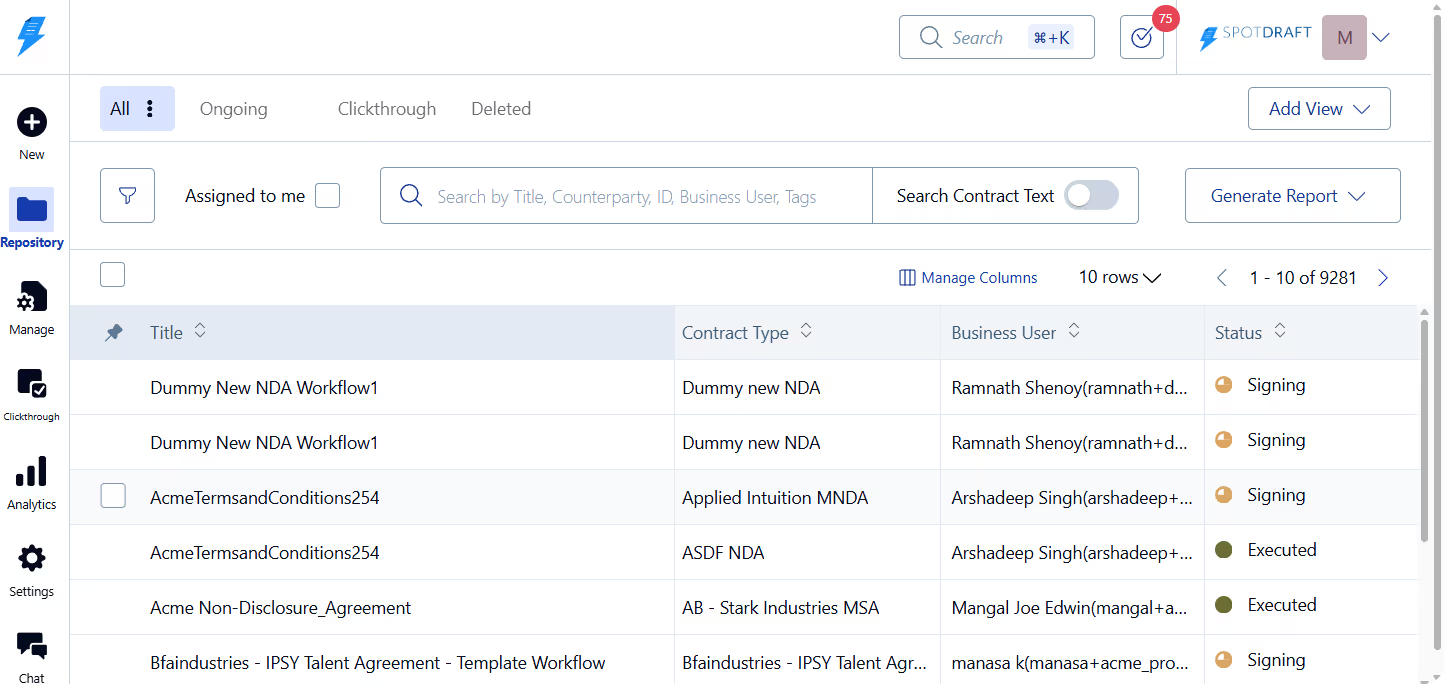
SpotDraft is a modern CLM solution built to help fast-scaling legal operations teams manage high contract volumes efficiently. It emphasizes automation, collaboration, and analytics while staying accessible for teams that do not have extensive IT support. SpotDraft’s intuitive design and automation depth make it ideal for in-house legal teams seeking process control without enterprise complexity.
SpotDraft’s Key Features
AI-assisted drafting and redlining
Central dashboard for workflow management
Repository and search
Analytics dashboard
Integrations for Salesforce, Slack, Gmail
Pros and Cons of SpotDraft
Pros
Cons
High degree of workflow automation for legal operations teams
Workflows can be rigid; e.g., limited flexibility in multi-party scenarios and reporting dashboards
Built-in analytics and reporting improve visibility
AI capabilities (e.g., for contract review) need more work
AI-assisted redlining shortens negotiation cycles
Reviewers have lauded support quality
SpotDraft Pricing
Custom pricing is available upon request and is based on either users or contract volume. It offers proper guided onboarding and 24x7 support to all its customers at no extra cost.
Where SpotDraft Wins Over Checkbox
Provides AI-assisted drafting and negotiation instead of static form-based workflows
Offers stronger analytics and visibility into contract performance
Better suited for fast-scaling legal departments and growing enterprises
6. DocuSign CLM: Best for Enterprises Already in the DocuSign Ecosystem
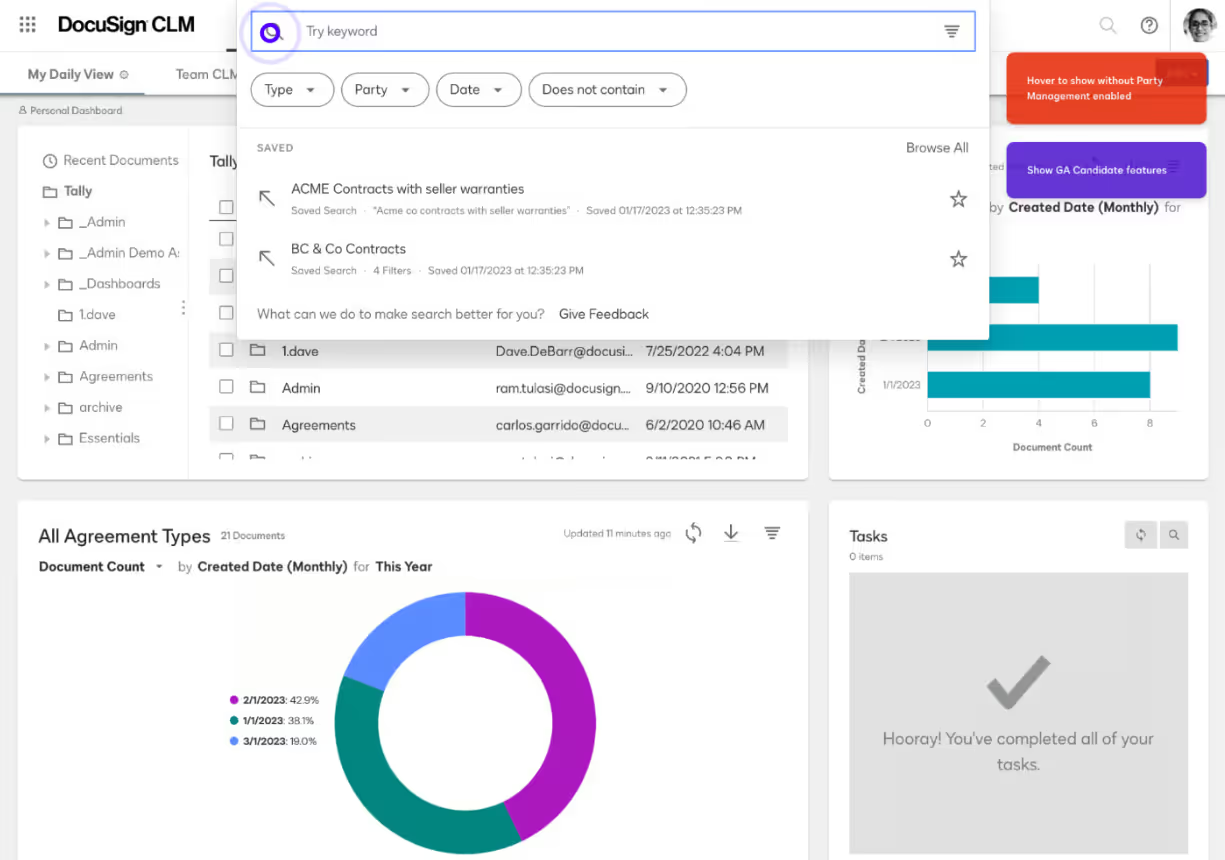
DocuSign CLM extends the functionality of DocuSign’s industry-leading eSignature platform into full contract lifecycle management. It is built for enterprises already within the DocuSign ecosystem. The CLM enables organizations to automate approvals, manage compliance, and centralize contracts. Users have praised DocuSign CLM’s reliability and strong integration capabilities, though setup and user onboarding may be complex for new users.
DocuSign CLM’s Key Features
Native eSignature integration
Workflow automation and standardized templates
Searchable contract repository
Compliance and audit tracking
Analytics and reporting
Pros and Cons of DocuSign CLM
Pros
Cons
Deep integration within the DocuSign suite; familiar for existing users
Implementation can be lengthy and costly, with a steep learning curve and complexity
Strong compliance and audit features
Aging interface
Secure and reliable infrastructure for enterprise-scale deployments
Potentially limited flexibility outside of DocuSign’s ecosystem
DocuSign CLM Pricing
Enterprise pricing is available on request. DocuSign CLM is typically positioned toward mid-to-large enterprises with existing DocuSign investments.
Where DocuSign CLM Wins Over Checkbox
Provides end-to-end CLM with native eSignature integration and advanced auditability
Delivers higher compliance assurance for enterprises in regulated industries
Better suited for organizations already standardized on DocuSign tools
7. ContractWorks (Onit): Best for Repository and Audit Control
ContractWorks, part of the Onit portfolio, focuses on secure contract storage, tracking, and compliance oversight. It’s ideal for teams that want a simple yet powerful repository without the overhead of full CLM deployment. Reviews on legitimate platforms have highlighted an easy setup combined with exceptional value, especially for audit-driven teams.
ContractWorks’s Key Features
Centralized repository
Smart document tagging
Audit trails and reminders
Reporting dashboard with visual summaries
E-signature integration
Pros and Cons of ContractWorks
Pros
Cons
Simple deployment with minimal IT dependency
Limited workflow automation compared to full CLM platforms
Excellent search, tracking, and reporting features
Not designed for complex contract authoring or negotiation
Highly rated for customer support and reliability
Lacks native AI analytics
ContractWorks Pricing
There are three tiers customers can choose from: Standard, Professional, and Premium, based on document volume and storage requirements. All three tiers come with unlimited users.
Where ContractWorks Wins Over Checkbox
Purpose-built for compliance-heavy teams needing reliable repository control
Offers faster setup and lower cost than Checkbox or larger CLMs
Provides clear visibility and audit readiness out of the box
8. Icertis: Best for Global Enterprises with Complex Compliance Needs
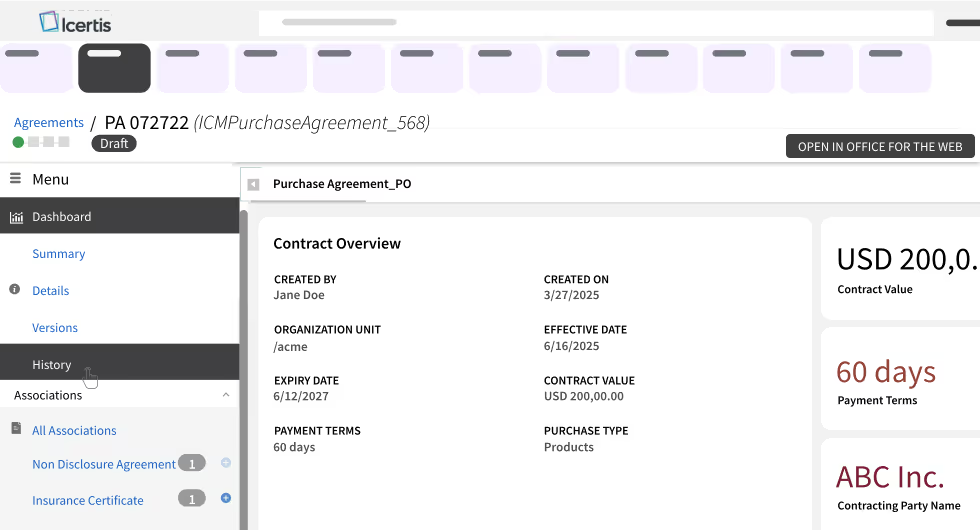
Icertis is a global leader in enterprise contract lifecycle management. It is known for its advanced AI and compliance management capabilities. The platform is built for multinational corporations and is designed to help legal and procurement teams standardize and enforce policies across jurisdictions. Past user reviews frequently highlight its scalability and comprehensive governance features, though they also mention a steep learning curve.
Icertis’s Key Features
AI-powered analytics
Global compliance framework
Connects with major ERP and CRM systems
Customizable workflows and rule-based automation
Risk and performance dashboards
Pros and Cons of Icertis
Pros
Cons
Unmatched scalability for multinational organizations
Complex implementation process requiring dedicated support
Deep AI analytics and risk management capabilities
High total cost of ownership relative to smaller CLMs
Extensive integration ecosystem and configurable architecture
Users report a steep learning curve for non-technical teams
Icertis Pricing
Icertis has not published any pricing information, but it is primarily positioned as a premium solution for large-scale legal operations, which means it comes with a hefty price tag.
Where Icertis Wins Over Checkbox
Delivers unmatched AI and compliance intelligence compared to Checkbox’s basic workflow automation
Scales across global operations with unified oversight and localization features
Provides advanced risk analytics and contract visibility critical for enterprise governance
Pricing and Suitability of Top Checkbox Alternatives
Platform
Pricing Transparency (Relative)
Ideal For
Avokaado
High
BFSI, Telecom; legal ops, HR, revenue
Ironclad
Low
Large enterprises
Juro
High
Legal teams under 500
Contractbook
High
SMBs
SpotDraft
Low
Legal ops
DocuSign CLM
Low
Enterprises
ContractWorks
High
Audit-focused teams
Icertis
Low
Multinationals
How to Choose the Right Alternative for Your Legal Team
Choosing the right alternative to Checkbox depends on your organization’s goals, size, and risk posture. Here are key factors to evaluate before committing to a new CLM or workflow platform provider.
Scope: Be clear on whether you’re seeking to automate simple workflows or transform your full contract lifecycle with data visibility and analytics. If you only need intake and approvals, lighter automation tools like Juro or Contractbook may suffice. For strategic transformation, enterprise-grade CLMs such as Avokaado, Ironclad, or Icertis are better fits.
Compliance: Make GDPR, ISO 27001, SOC 2, and audit-trail readiness a priority. For BFSI or telecom organizations, platforms like Avokaado or Icertis offer the strongest compliance foundations with built-in governance modules.
Integration: Assess whether the system integrates smoothly with your CRM, ERP, or HRIS stack, such as Salesforce, Workday, or BambooHR. Avokaado and Ironclad excel here with robust integration ecosystems.
Scalability: Think about future growth. Mid-market teams can start with Juro or Contractbook and upgrade later, while global enterprises will need scalable CLMs like Ironclad or Icertis that support multilingual workflows and data governance. For more flexibility, you can consider a platform like Avokaado.
Onboarding Speed and Support: Implementation times vary widely across providers, from a few days with Avokaado to several months for larger systems. Go through the vendor’s customer success stories and check if local support is available.
ROI and Performance: Compare pricing models (usage-based vs per-seat) and measure expected time savings, compliance risk reduction, and cycle-time improvement. You will have to balance automation depth with measurable business outcomes for successful deployment.
Wrapping Up
Legal automation has entered a transformative phase. What started as document management and workflow automation has evolved into contract intelligence, a move from paperwork to data-driven decision-making.
Today’s leading platforms, including Avokaado, Ironclad, and Icertis, demonstrate how legal operations can become strategic rather than reactive. The shift isn’t just about efficiency; it’s about giving legal teams oversight, governance, and measurable impact.
AI governance and explainability are now core expectations.
Modern CLMs integrate seamlessly with business systems for company-wide visibility.
Predictive and agentic automation is setting the new standard for 2025 and beyond.
In short, the future of legal operations belongs to teams that treat contracts as data, and to platforms that turn that data into intelligence and strategy.
Avokaado leads this transformation, replacing patchwork tools with AI native contract intelligence and enabling teams to work faster, safer, and smarter. Checkbox may have been an early starter on the wave of automation, but Avokaado perfects it.
Book your Avokaado demo today and experience how governed automation can replace legal chaos with clarity.
FAQs
Is Checkbox a CLM system?
No. Checkbox positions itself as a no‑code intake, matter, and workflow automation hub for legal teams that is not a full contract lifecycle management (CLM) platform, but works on top of one. Its own site treats CLM as a distinct category that manages contracts end‑to‑end and is often complementary to Checkbox.
What is the best Checkbox alternative for regulated industries?
For heavily regulated sectors such as banking and finance, telecom, and public services, Avokaado is the most suitable alternative. It offers GDPR-compliant infrastructure, governed AI automation, and detailed audit trails designed specifically for compliance-heavy environments.
How fast can I implement Avokaado compared to other CLMs?
Avokaado typically takes less than one week to go live, with a 24-hour pilot option available for validation. In contrast, traditional enterprise CLMs like Ironclad or Icertis often require several weeks or months due to their complex configuration and integration requirements.
Can I use Avokaado outside legal departments?
Yes. Avokaado is designed for cross-functional use. Sales, HR, and Procurement teams can independently generate, route, and manage contracts while Legal maintains control through governance settings and workflow rules.
Is Avokaado more affordable than, say, Ironclad or Icertis?
Yes. Avokaado’s modular and usage-based pricing model allows teams to scale according to activity instead of per-user fees. This makes it more cost-effective for medium and large organizations, especially when compared to enterprise-priced systems such as Ironclad or Icertis.
Get back in control
See how Avokaado replaces chaos with clarity by automating manual work, cutting delays, and giving you full visibility across every document.